ABG Practice Tutor · Free
ABG interpretation practice that asks you the questions.
Work fictional arterial blood gas cases one step at a time. The tutor asks one question, checks your answer and, when you slip, asks a better question instead of giving the answer away. Every case ends with a test-day breakdown you can keep.
For nursing, respiratory therapy, PA, pharmacy and medical students. No account, nothing uploaded.
Why ABG interpretation is hard to practise
Most students can recite the normal ranges. The trouble starts with the second disorder: a "normal" PaCO2 that is too high for the acidosis, a low HCO3 that is really chronic compensation, or an anion gap that looks normal only because the albumin is low. Worksheets give you the answer at the bottom, and calculators give it to you straight away, so you never find out which step you would have missed.
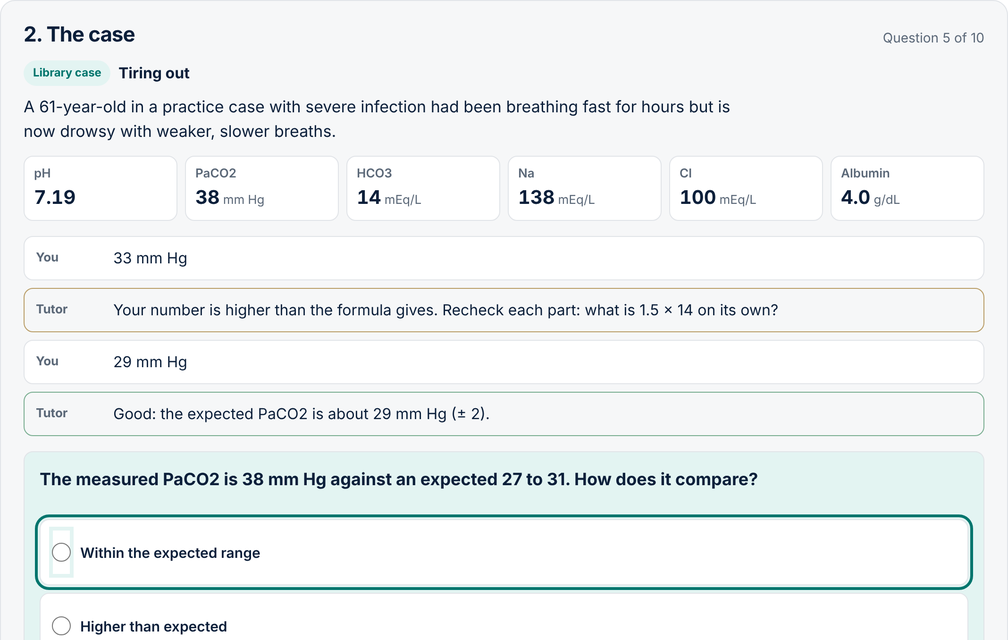
ABG Practice Tutor withholds the answer. You commit to each step, and the tutor checks it against the numbers. When you are wrong, it asks a question that points at the gap in your reasoning, such as "Is a PaCO2 of 38 really inside the range Winter's formula predicts?", until you get there yourself.
How the step-by-step ABG tutor works
1. Pick a case
22 fictional cases from single disorders to mixed disorders and hidden traps, or a quick numbers-only drill.
2. Answer one question
pH, primary process, exam wording, compensation, anion gap, albumin correction, delta ratio, then the final answer.
3. Get nudged, not told
Wrong answers and hints come back as guiding questions. Stuck? Open the breakdown any time.
4. Keep the breakdown
Each step's clue, reasoning, and what it rules in and out, plus the key insight. Copy or download it.
The acid-base steps you will practise
- pH. Acidemia below 7.35, alkalemia above 7.45. Normal ranges are pH 7.35–7.45, PaCO2 35–45 mm Hg and HCO3 22–26 mEq/L, though labs vary slightly (StatPearls, Arterial Blood Gas Analysis: Fundamentals, Interpretation, and Clinical Utility).
- Primary process. Which value moved in the direction that explains the pH? A normal pH with abnormal values usually means two processes.
- Exam wording. The ROME or tic-tac-toe label: uncompensated, partially compensated, fully compensated or combined.
- Compensation. Winter's formula for metabolic acidosis, and the rules of thumb for metabolic alkalosis and for acute versus chronic respiratory disorders (Merck Manual Professional, Acid-Base Disorders). Compensation that misses the prediction means a second disorder.
- Anion gap. Na − (Cl + HCO3), normal about 8 to 12 without potassium, corrected by adding 2.5 for each 1 g/dL that albumin is below 4.0 (StatPearls, Anion Gap and Non-Anion Gap Metabolic Acidosis).
- Delta ratio. (Gap − 12) / (24 − HCO3). Below 1 adds a normal anion gap acidosis; between 1 and 2 is a pure gap acidosis; above 2 adds a metabolic alkalosis (same StatPearls source).
Every case's pH is calculated from its HCO3 and PaCO2 with the Henderson–Hasselbalch equation, so the numbers always agree with each other.
Who it is for
- Nursing students learning ABG interpretation for exams and clinical rotations. Every case also asks for the ROME or tic-tac-toe label (uncompensated, partially or fully compensated) and shows where that wording differs from the method used for mixed disorders.
- Respiratory therapy, PA and pharmacy students who need acid-base practice beyond the basics, including mixed disorders.
- Medical students reviewing acid-base for board exams who want to find the step they keep getting wrong.
- Instructors who want a free practice set to assign between classes.
How to get the most from your arterial blood gas practice
- Do the arithmetic yourself, on paper if you like. The tutor checks numbers with a small tolerance for rounding.
- Use a hint before you open the breakdown. Hints are questions, and answering them is the practice.
- Check "Your progress" after five or six cases. First-try accuracy by step shows exactly where you lose points, and "Practise my weakest step" picks a case that exercises it.
- Repeat the hidden traps until you get every step right first time.
Pricing
The free tutor is complete and live now.
Free
- 22 fictional library cases and unlimited quick drills
- Step-by-step questioning with guiding hints
- Test-day breakdown for every case
- Progress by step, CSV history and JSON backup
Pro
or $29 a year, for one person
- A larger case library, including triple disorders and the osmolar gap
- Spaced review that brings back the steps you miss
- Timed exam mode with no hints
- Printable breakdown packets (PDF)
Team
for a nursing, RT or PA program cohort: up to 40 learners
- Everything in Pro for each learner
- Write your own fictional cases and share them as a case pack
- Assign packs with a due date
- Class summary of first-try accuracy by step
Pro and Team are in early access. Reserving a spot is free and nobody is charged until their plan is activated. The prices shown are the planned launch prices, and we will email you from [email protected] before anything is billed.
ABG practice FAQ
What are the steps of ABG interpretation?
Look at the pH (acidemia, alkalemia or normal), find the primary process from the PaCO2 and HCO3, check whether compensation is what the rules predict, calculate the anion gap (corrected for albumin), and if the gap is high, use the delta ratio to look for a second metabolic disorder. Then name every disorder you found.
Why does the tutor not just tell me the answer?
Because working it out is what sticks. Each wrong answer gets a question that points at the gap in your reasoning. You can ask for up to two hints per question, and if you are stuck you can open the full breakdown at any time; the case is then recorded as not solved on your own.
Which formulas does it use?
Winter's formula (expected PaCO2 = 1.5 × HCO3 + 8 ± 2) for metabolic acidosis; a PaCO2 rise of 0.6 to 0.75 mm Hg per 1 mEq/L HCO3 rise for metabolic alkalosis; HCO3 changes of 1 to 2 (acute) or 3 to 4 (chronic) per 10 mm Hg for respiratory acidosis and 1 to 2 (acute) or 4 to 5 (chronic) for respiratory alkalosis; anion gap = Na − (Cl + HCO3) with a normal range of about 8 to 12; corrected gap = gap + 2.5 × (4.0 − albumin); and delta ratio = (gap − 12) / (24 − HCO3). These are rules of thumb; your course may teach slightly different numbers.
Does it use ROME or tic-tac-toe wording?
Yes. After the primary process, every case asks how ROME or tic-tac-toe wording would label the gas: uncompensated, partially compensated, fully compensated or combined. Where a nursing exam would say fully compensated (a normal pH with both values abnormal), the tutor also explains that physiologically this usually means two opposing disorders, which is how the final answer is graded. Follow your course's wording on your exam.
Are the cases real patients?
No. Every case is fictional and written for teaching. The pH in each case is calculated from the HCO3 and PaCO2 with the Henderson–Hasselbalch equation, so the numbers are consistent. Quick drills are computer-generated numbers with no story.
Can I enter my patient's blood gas?
No. ABG Practice Tutor is for education only and does not accept or interpret real patient results. For patient care, use your institution's resources and clinical judgment.
Where is my progress stored?
Only in your browser's local storage on the device you use. Nothing is sent to MedRise. Back up saves a file you can restore on another device, and Clear my data deletes everything.
Find the step you keep missing
Free, private and ready in your browser. Working on a QI project too? Try the QI Run Chart.
Education only. ABG Practice Tutor teaches a common stepwise method for acid-base interpretation using fictional practice cases and rule-of-thumb compensation formulas. It is not a clinical decision tool, does not interpret real patient results and does not give diagnosis or treatment advice. Rules and normal ranges vary by source and laboratory; follow your course materials and current references. It is not for patient information. See the terms and disclaimer and privacy notice.