Hand Hygiene Audit Dashboard · Free
A hand hygiene audit tool that makes the report for you.
Tap once per opportunity: the moment, then handrub, handwash or missed. The dashboard turns your observations into compliance by month, WHO moment, staff role and unit, with honest 95% intervals and your goal line.
For infection preventionists, nurse managers and quality leads in hospitals, surgery centers, clinics and long-term care. No account, nothing uploaded.
Why hand hygiene audits take longer than they should
Watching for opportunities is the easy part. The work starts afterwards: paper tally sheets, a spreadsheet that only one person understands, and a monthly scramble to produce a percentage per unit for the infection control committee. Enterprise observation systems are priced and contracted for large hospital systems. Surgery centers, clinics, dialysis units and long-term care homes are often left with clipboards.
There is also a quieter problem: small samples. A unit with 11 of 14 opportunities performed reports 79%, but the 95% interval runs from about 52% to 92%. Reporting that number without context leads to the wrong conversations. The WHO Hand Hygiene Technical Reference Manual suggests about 200 opportunities per observation period and per unit before comparing results, and most small teams cannot reach that every month.
The Hand Hygiene Audit Dashboard is a free hand hygiene compliance tracker built for that reality. It is fast enough to use while you observe, it records the five WHO moments, and every chart tells you how much to trust the number it shows.
How the hand hygiene compliance tracker works
1. Set the session
Date, unit or area, and the staff role you are watching. The tool remembers your units.
2. Tap each opportunity
Pick the moment (1 to 5), then Handrub, Handwash or Missed. Undo fixes a mis-tap. Or copy a whole paper observation sheet into a 5-moment grid.
3. Read the dashboard
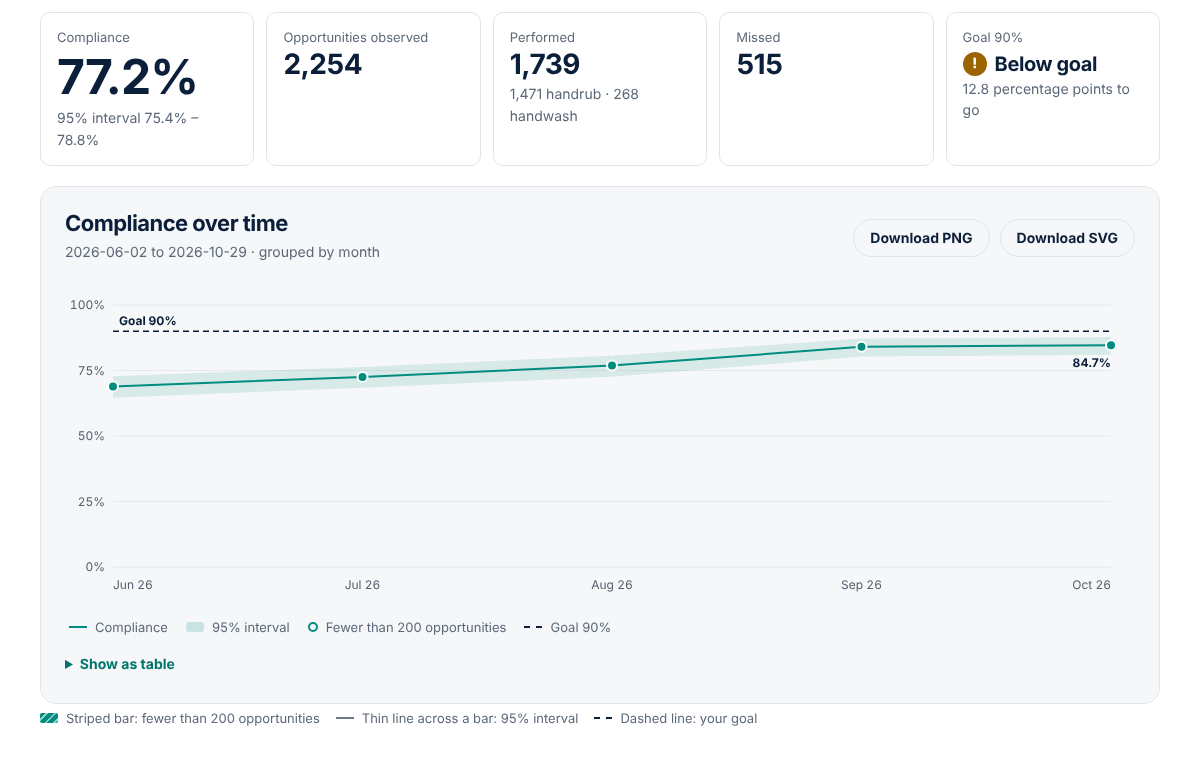
Compliance over time with a 95% interval band and goal line, plus compliance by moment, role and unit, weakest first.
4. Report it
Download the chart as PNG or SVG for slides, export a summary CSV for the committee, and keep the raw CSV as your record.
The method, in plain terms
- Compliance = hand hygiene actions performed ÷ opportunities observed × 100, the formula in the WHO manual. A handrub or handwash counts as performed.
- The five moments: before touching a patient, before a clean or aseptic procedure, after body fluid exposure risk, after touching a patient, and after touching patient surroundings.
- 95% interval: a Wilson score interval around every percentage. A wide band means "observe more before drawing conclusions".
- Small samples flagged: hollow points, striped bars and an asterisk in the unit-by-period table mark any group with fewer than 200 opportunities.
- Your goal, not ours: the Joint Commission's hand hygiene FAQ says organizations follow CDC or WHO guidance and set their own improvement goals, with no specific numerical target. Enter yours and every chart shows it.
Who it is for
- Infection preventionists who need monthly compliance by unit and by moment without rebuilding a spreadsheet.
- Nurse managers and charge nurses running unit-level audits and huddle feedback.
- Ambulatory surgery centers, clinics, dialysis and long-term care teams that audit by hand and report to a small committee.
- Nursing and public health students and faculty learning how observation audits and sample size work, using the fictional example.
How to run a hand hygiene audit with this tool
- Open the tool on a phone or tablet. On the Record tab, enter the date and unit and choose the role you will watch first.
- Observe for a set period; WHO suggests sessions of about 20 minutes, give or take 10. For each opportunity, tap the moment, then what happened.
- Switch the role whenever you start watching someone in a different role. Never record names.
- Prefer paper on the unit? Use "Enter tallies from a paper form" afterwards: one sheet at a time, with handrub, handwash and missed counts for each of the five moments.
- Set your organization's goal under Data and settings.
- Open the Dashboard, filter by date, unit or role, and download the chart and summary CSV for your report.
Pricing
The free tool is complete and live now.
Free
- One-tap recording by WHO moment, role and unit
- Paper-sheet tally grid and Excel-friendly CSV import
- Dashboard by month, moment, role and unit with 95% intervals, goal line and a unit-by-month table
- PNG download of every chart; summary and full CSV export
Pro
or $79 per year
- Account with observations synced across your devices
- One-page PDF monthly report for the infection control committee
- Extra fields: glove use, feedback given on the spot, observer initials
- Your own role and unit lists
Team
for a facility or infection prevention department; annual invoicing available
- Everything in Pro for up to 25 observers
- Several observers recording into one shared dashboard
- Read-only unit views for managers
- Observer-to-observer agreement check for validating auditors
Pro and Team are in early access. Reserving a spot is free and nobody is charged until their plan is activated; we will email you from [email protected] with the final price before anything is billed.
FAQ
How is hand hygiene compliance calculated?
Compliance is the number of hand hygiene actions performed divided by the number of opportunities observed, times 100. This is the method in the WHO Hand Hygiene Technical Reference Manual. A handrub or a handwash counts as performed; a missed opportunity counts against compliance.
What are the WHO 5 Moments for hand hygiene?
Moment 1: before touching a patient. Moment 2: before a clean or aseptic procedure. Moment 3: after body fluid exposure risk. Moment 4: after touching a patient. Moment 5: after touching patient surroundings. The tool records every opportunity against one of these five moments.
How many observations do I need?
WHO suggests about 200 opportunities per observation period and per unit before results are compared. The Joint Commission's hand hygiene FAQ sets no numerical target and does not require observing every opportunity; organizations choose their own monitoring approach. The dashboard shows a 95% interval for every number and marks any period, moment, role or unit with fewer than 200 opportunities, so a small sample is never mistaken for a firm result.
Is there a required compliance target?
The Joint Commission says organizations set and document their own improvement goals and that there is no specific numerical target. Enter your own goal in Data and settings; the dashboard then marks each group as at or above goal or below goal.
Can I enter patient or staff names?
No. Record only the date, unit, staff role category, moment and what happened. The tool refuses unit entries that look like room, bed or record numbers, and it has no field for patient or staff names. It cannot recognize every name, so the person entering data is responsible for keeping names out. Feedback to individuals belongs in your program's own process.
Where is my data stored?
Only in your browser's local storage on the device you use. Nothing is sent to MedRise. Export CSV saves every row as a backup you can import on another device, and Clear my data deletes everything the tool saved.
Does a high audit score mean staff always clean their hands?
Not necessarily. People change their behavior when they know they are being watched (the Hawthorne effect). One hospital study in BMJ Quality and Safety found hand hygiene events were about three times more frequent in hallways when auditors were visible. Treat direct observation as one signal and rotate observers, times and units.
Sources: WHO Hand Hygiene Technical Reference Manual (2009); Joint Commission, Hand Hygiene: key components of a compliant program; Srigley et al., BMJ Quality & Safety 2014.
Start your next audit here
Free, private and ready in your browser. Load the fictional example first to see a full dashboard in one click.
Education and workflow support only. The Hand Hygiene Audit Dashboard summarizes observation audits for quality improvement. It does not monitor individuals, diagnose or treat anyone, or replace your infection prevention program's policies, your organization's review, or current CDC and WHO guidance. Never enter patient or staff names. See the terms and disclaimer and privacy notice.