Research Project Chooser · Free
How to choose a research project you can finish, and that matters.
Put the projects you are choosing between side by side. Rate the impact of each, list what must go right, and see the chance of success, the risky assumptions and whether it can finish before your residency application deadline. No account, no upload.
For medical students, residents and fellows. Projects only, never patients.
The project you pick matters more than how hard you work on it
Many trainees choose a research project in a hallway conversation: a faculty member has an idea and you say yes. Months later the data turn out to be hard to get, the approval takes longer than expected, or the result you need never appears, and the application deadline arrives with nothing to show.
Stanford bioengineer Michael Fischbach makes the same point for scientists: people "often spend days choosing a problem and years solving it" (Fischbach, Cell 2024). His framework judges an idea by its likelihood of success and its impact if it succeeds. He developed it with his late mentor Christopher Walsh, and he advises naming the risks openly rather than hoping they go away (Stanford Report). Research Project Chooser applies that thinking to the projects trainees actually choose between.
How the research project chooser works
1. Set your deadline
The date you need something to show, such as your residency application.
2. Add your options
Up to eight projects: type, mentor role, deliverable, fallback and the one thing you will keep fixed.
3. List the assumptions
What must be true, how likely it is (1 to 5) and how many months until you know.
4. Compare and decide
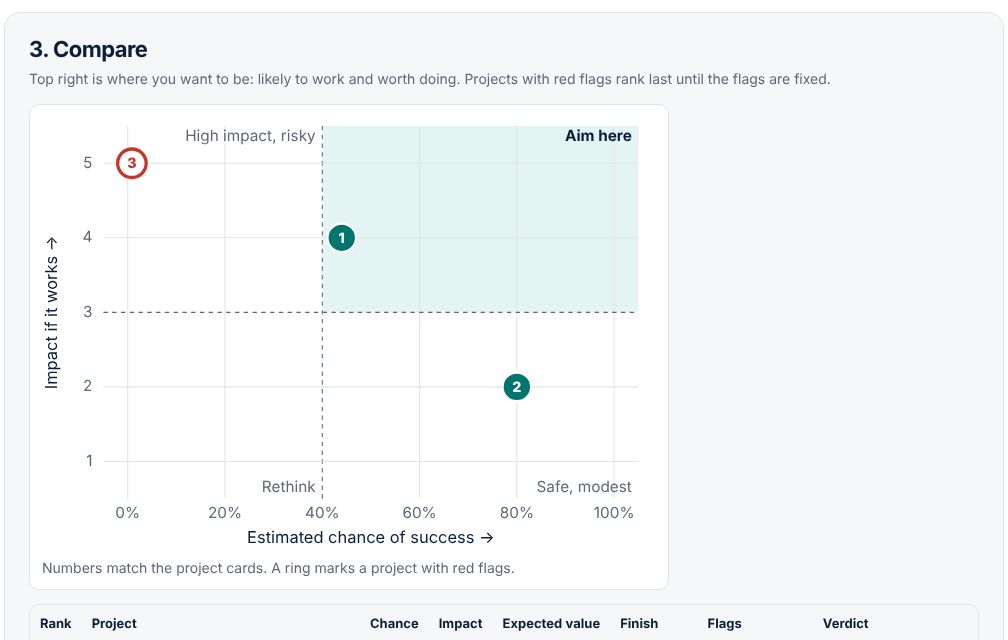
A likelihood × impact chart, a ranked table, red flags and a one-page mentor summary.
A research project risk assessment in five minutes
For each assumption you choose a risk level from 1 (very likely to hold, over 90%) to 5 (very unlikely, under 10%) and the number of months until you will find out. The tool then flags the patterns that sink trainee projects:
- A late high-risk assumption. If the thing most likely to fail will not be known until past the halfway point to your deadline, find a quicker, cruder test first, such as asking the data team for a count before you commit.
- Several miracles. Three or more unlikely assumptions means the project should be reframed or dropped.
- The riskiest test last. Easy early work can hide a fatal problem. Test the riskiest assumption first.
- No fallback. Name what you can still present if the main result fails, such as a case report or a literature review.
- Nothing fixed, or everything fixed. Pick one thing to hold steady, usually the question or the mentor, and let the rest change.
- A finish date after your deadline, from your last read-out plus the time you need to write up and submit.
Who it is for
- Medical students deciding which medical student research project to join before applications. The NRMP Charting Outcomes reports describe applicants' research experiences and their abstracts, presentations and publications by specialty (NRMP, July 2026).
- Residents and fellows choosing a scholarly project, or a project for a fellowship application.
- Research mentors and student research offices who want students to arrive at the first meeting with their options thought through.
Research for the residency application is not everything: the AMA notes that research is not required to secure a residency position and that interest should come from your own goals (AMA). That is why the tool lets your interest break ties, and why it values a project you can finish.
Tips for an honest score
- Try to convince yourself the project will fail. The assumptions you would rather not write down are the ones to list.
- Ask the mentor and the data team the riskiest question in the first week.
- Count your own time as an assumption. Clerkships, call and step exams are real constraints.
- Rate impact on two axes, how much it will teach and how many people will care. A high score on either is enough.
Pricing
The free chooser is complete and live now.
Free
- Up to 8 projects and 12 assumptions each
- Likelihood × impact chart, ranking and red flags
- Read-out timeline against your deadline
- Printable mentor summary, CSV and JSON backup
Pro
one payment for one person, covering 12 months: one application cycle. No subscription.
- Track the chosen project: milestones, go/no-go dates and calendar (.ics) reminders
- Abstract, poster and paper submission tracker with conference deadlines you enter
- Unlimited projects and a history of how your ratings changed
- Word and PDF export of the mentor summary
Team
for a student research office, research track or residency program: up to 50 people
- Everything in Pro for each person
- Mentors comment on and approve a student's choice
- Program view of every student's project, flags and status
- A shared list of open projects from faculty
Pro and Team are in early access. Reserving a spot is free and nobody is charged until their plan is activated. The prices shown are the planned launch prices, and we will email you from [email protected] before anything is billed.
Research project FAQ
How do I choose a research project in medical school or residency?
Start with the projects you could realistically join, then for each one ask two questions: how likely is it to work, and how much will it matter if it does. List what must be true for it to work, from getting the data to the result itself, rate how likely each assumption is and when you will know. Prefer a project whose riskiest assumption you can test in the first weeks, that has a fallback deliverable, and that can finish before your deadline.
How is the chance of success calculated?
Each assumption gets a risk level from 1 (very likely to hold, over 90%) to 5 (very unlikely, under 10%), and the tool uses the middle of each band. Every uncertain assumption (risk 3 to 5) is something separate that must go right, so their chances are multiplied; the likely ones (risk 1 or 2) count once, through the least likely of them, so listing more safe assumptions does not lower your score. It is a rough estimate from your own ratings, meant to show when a project needs several unlikely things to go right, not to predict an outcome.
What counts as a red flag?
A high-risk assumption you will not be able to test until late, three or more unlikely assumptions (a project that needs several miracles), an estimated finish after your deadline, or anything that looks like patient information. Cautions include testing your riskiest assumption last, having no fallback deliverable and not choosing the one thing you will keep fixed.
Does research matter for the residency match?
It depends on the specialty and the program. The NRMP Charting Outcomes reports describe the research experiences and the abstracts, presentations and publications of applicants by specialty, and the AMA notes that research is not required to match. A finished project you can talk about is worth more than several that never end, which is why the tool checks your deadline.
Can I enter patient information?
No. Describe projects, not patients. Never enter names, record numbers, dates of birth or other identifiers, and write mentors as roles. The tool warns you about some common identifiers, such as record numbers, full dates, phone numbers and email addresses, but it cannot catch everything, so check what you type.
Where is my data stored?
Only in your browser's local storage on the device you use. Nothing is sent to MedRise. Back up saves a file you can restore on another device, and Clear my data deletes everything.
Know which project to say yes to
Free, private and ready in your browser. Planning a QI project instead? Try the QI Family of Measures Planner.
Education and workflow support only. Research Project Chooser helps you think through which project to take on. Its scores come from your own ratings and are not predictions. It does not decide whether a project needs IRB review (ask your IRB or research office), does not give research ethics, legal or career advice, and does not replace your mentor's judgment. It is not for patient information. See the terms and disclaimer and privacy notice.